Showing posts with label Black Cat. Show all posts

Shards/Ismet Prcic: Reflections

Tuesday, November 29, 2011

Two nights ago, just after I'd slipped the steaks onto their plates, a gold-dipped wine glass tumbled from a top cabinet shelf, just like that.  I hadn't touched it.

The glass, the gold, scattered to all ends of the kitchen and out into the hall.  I spent a long time collecting the pieces, and then yesterday, illuminated by the spot of sun that wedges through the front door, I discovered that the shards had multiplied overnight; they were still there, still bristling with danger.

I was thinking of that shattered glass early this morning as I finished reading Shards, the debut novel by Ismet Prcic.  I bought this book because I know Lauren Wein, its editor.  I bought it because others have expressed their astonishment.  I bought it because it has the word "propulsive" in the jacket copy.  I like that word.  It doesn't belong to me or my work, it may not ever, but it absolutely belongs to Prcic and Shards.

My word, where to begin?  First, as I noted here in a previous post, you're not going to find many sentences in any book, anywhere, like the sentences you find here.  One after the other after the other.  Prcic makes use of preposterous and somehow dead-on analogies and allusions, profanities and profundities.  He celebrates the hieroglyphs of punctuational tics, smears words, elevates typefaces, deploys footnotes, diary entries, memoirisms, blasphemy, theater, treachery, vulgarisms, and you know what?  It works.  It's not cute.  It's not invention for invention's sake.  It's not ponderous:  Prcic needs every thing that language surrenders to tell his heartbreaking, rude, surprisingly compassionate, and still violent story about a Bosnian refuge who is trying to make sense of his new life in southern California.  What did Prcic (for indeed, that is the character's name) leave behind?  Who did he leave behind?  At what cost, his own survival?

I could write a mile-long review and fail at explaining this book.  Frankly, I think any reviewer would feel the same way, or should.  There's an easy explanation for this lack of explanation:  this book cannot be explained.  It is to be experienced.  Sentence by sentence, scene by scene.  I quoted a favorite early passage in that blog post of the other day.  Here I'll quote another:
Movies don't do it justice—that's all I'm going to say about the thought-collapsing, breath-stealing sound a spinning shell makes as it pierces the air on the way down toward the center of your town, in between three of the busiest cafes and a little bit to the right of the popcorn vendor in the midst of hundreds of citizens who are pretending that everything is okay, that the war is winding down.  But I didn't know that yet.

Read more...

Going Home: Ein Konzert fur die Berliner Domstiftung

Sunday, June 19, 2011


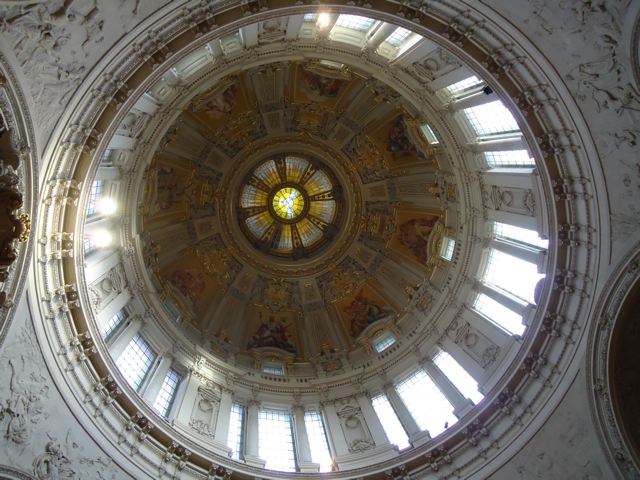
We spent the final evening not as tourists but as audience within the Berliner Dom. The thirty members of the Berliner Domkantorei gathered, to begin, at the back of this cathedral, lifting their voices up, then moved progressively and finally en masse toward the altar. The Berliner Domblaser, a brass ensemble, answered their song. The organ responded. It was eight in the evening, and we were far from that crowd, beneath that magnificent dome, unbothered by the worldly silences or professional frustrations we did manage to leave entirely at home.

Nothing bothered me here. All was new, an invitation. I leave Berlin with a fuller understanding of a devastating regime, a great respect for a city's ability and willingness to rebuild, a broader alignment with architecture both restorative and radical, and a love for the gentle grunge and craftsmanship of a proliferated artist community.

The skies, by the way, are exactly as Chloe Aridjis describes in her evocative and powerful slender novel, The Book of Clouds, which led me, like the great historian and writer Paul Steege led me, like my friend Tamra led me, to this city.

It had been a long time since I traveled like this. I am different than I was, and different than I will no doubt now be.

Thanks for journeying with me.


Read more...

Kamchatka/Marcelo Figueras: Reflections

Wednesday, January 5, 2011

Because I can't find the right photograph, because maybe this is the right photograph—these birds leaving but also going toward.  Because "time," Marcelo Figueras writes in his masterful Kamchatka, "is weird."  Because time bends, and when we are reading novels like this one—so rich with knowing, and yet so vulnerable—time doesn't exist at all.

The year is 1976, the place is Buenos Aires, and there is a family on the run from the military now in power.  A ten-year-old boy is telling this story, but not really—it is the ten-year-old remembered by a later self looking back, by a man who writes, early in these pages:
Every day, life gives us an intimation of this.  We sense that, inside us, every 'we' we once were (and will be?) coexists:  the innocent self-absorbed child, the sensual young man generous to a fault, the adult, feet planted firmly on the ground yet still clinging to his illusions, and finally we are the old man who knows that gold is just another metal; as his eyesight fails he has acquired vision
So that we meet the family as the boy recalls his family—the sensationally imperfect and wholly loving mother who abruptly pulls her children from school; the father who joins them at a safe house outside the city; the brother Midget; the comrade Lucas; the surviving grandparents.  It's just a family and they're just living—trying to keep the toads from committing suicide in the pool, playing killer games of Risk at night, mixing up their chocolate milk, watching nostalgic movies, and staying, always, one step ahead of those who hope to disappear them.  You know how this story ends within the very first line of the book:  "The last thing papa said to me, the last word from his lips, was 'Kamchatka.'"  But Figueras writes with such excellent authority that we are soon hoping against hope (as a ten year old boy hopes against hope) that fate will spare this family, that Houdini magic will keep them safe.

How can I share, in this small space, the brilliant texture of this book—the biology, history, and language lessons that Figueras weaves in through devastatingly beautiful domestic scenes, the big riffs on life, the insistence on love?  I felt as if I were watching some of my favorite movies of all time, "My Father's Glory" and "My Mother's Castle."  I wanted to stop time, but I can't stop time, and even so, it took me several days to read to the end.

Kamchatka was first published in 2003; its author is both a screenwriter and a novelist, and indeed this book appeared on the silver screen some nine years ago.  Black Cat is bringing the book out sometime this spring for American audiences.


You're going to thank them for that.

Read more...

Purge/Sofi Oksanen: Reflections

Friday, December 31, 2010


I end this year privileged with time—time to read and to reflect, time to walk and to spend an afternoon, and then again an evening, with friends.

I take no ounce of time for granted.

This afternoon, in the quiet of my family room, I finished reading Purge, the international bestseller by Sofi Oksanen.  It is a story that begins with a fly in an old woman's house—a dirty fly, an invincible fly, a bother.  Aliide Truu would like to kill that fly, but soon something more distracting has entered her view—a hump or lump of something crumpled at the foot of the birch outside.  Aliide has had plenty to fear in life and she is, by some, despised, and it takes her a long time to decide to investigate that lump.  It takes her even longer to decide what to do after she realizes that the lump is a girl—battered, bruised, torn, filthy. A girl at the base of the birch.  Her name is Zara.  She is, Aliide will learn in time, a victim of the sex-trafficking trade and, more than that, a girl with a tie to Aliide's own sorted and shameful past.

Aliide and Zara, then, are the protagonists of this haunting book—two women whose lives have been defined by politics and treason.  Aliide, for her part, is the victim of those wretched forces of oppression that ruled Estonia for much of the 1940s; she is also the victim of her own lust for her sister's husband.  Zara is the victim of her own innocence and desire:  promised money for a job she did not understand, she took the bait, and suffered.  Is there any rescue left in these two women?  Can they save each other, or themselves?  Working with snatches of stories and letters and reports, Oksanen goes back and forth in time, exposing horrors, incriminating, exculpating, braiding these lives around each other.  She is not seeking quiet lyricism on these pages, simple entanglements.  Instead, she is pulling back the curtains on a part of the world, and a chapter of history, that I for one knew little of. 

Pay attention, Oksanen says.  There are women being brutalized by sex trafficking, even today.  There are people living with facsimiles of themselves, impossible regrets.  There are landscapes terribly unknown to us and wars we haven't studied.  Open the book, and read.  Taking nothing at all for granted.

Read more...

Vida/Patricia Engel: Reflections

Sunday, December 26, 2010

Last night I was explaining to my brother how you don't get perfect from perfect.  Glass deflects, I said.  Airtight frames let no one in.  You get perfect from raw and real, from quest and search, from words that feel ripped out, not placed.  You get it from writing that honors bewilderment, that shapes it, even, from stories and language that make you feel.  I said these things, and then I went to bed and when I woke up I read Vida, Patricia Engel's debut collection (Black Cat), from start to finish.

Exhibit A:  My kind of perfect.

You're going to want to know what Engel's stories are about.  I'm going to tell you to go read them.  To find out what a writer born to Colombian parents and raised in New Jersey and residing now in Florida makes of a character named Sabina, who shares at least some of her author's lineage.  Sabina carries these stories; mostly she tells them.  She takes us into shame, confusion, unrest, dishonor, one version or another of love, and of love's betrayals.  She gives us ascent and tip and instability, and in every single story, I believed I was reading the true.  I believed that a woman could hurt like this, want like this, wish herself to be someone other than this.  I believed a woman living this kind of life would make this kind of poetry.  The point is:  I believed.

And can we talk about language?  Can I give you this?
Just when I've beaten the night, I feel his arm on me.  Lou shaking me from my half sleep, his muscular fingers tugging my skin.  The darkness breaks with the glow of the street, spots of car lights on the walls, shining right through Lou so he looks as if he has a halo.  He turns on a lamp.  He's got a guitar hanging from a strap on his back and another, which he hands to me.  I sit up, let the quilt become a pond around my waist.  Take the guitar from him and run my fingertips over the fat metal strings.
That's from a story called "Refuge," the hands-down best post-9/11 piece of writing I've ever read.  Because 9/11 is both backdrop and mood, but it isn't, ultimately, the story.

Patricia Engel does not need me to sing her praises.  Vida is, among other things, a New York Times Notable Book of 2010, a Barnes & Noble Best Book of the Year, a New York Times Editors' Choice, and a Los Angeles Times Gift Guide Selection.  It is the debut that Junot Diaz said he'd been waiting for.

Vida is alive.  It trembles.

Read more...

The Hole We're In/Gabrielle Zevin: Reflections

Saturday, December 25, 2010

I've been wanting to read a Gabrielle Zevin novel for quite some time, and after all the festivities of Christmas were bowed out and complete, I slipped away to the brand-new couch with Zevin's newest novel for adults in hand.  "Meet the Pomeroys:  a church-going family of five living in a too-red house in a Texas college town," the flap copy reads.  "Roger, the patriarch, has impulsively decided to go back to school, only to find his future ambitions at odds with the temptations of the present.  His wife, Georgia, is trying to keep things afloat on the home front, though she's been feeding the bill drawer with unopened envelopes for months, and can never find the right moment to confront its scary, swelling contents...." 

Too-red house, I thought.  Feeding the bill drawer with unopened envelopes.  I was already keen on the sound of this book, the implied possibilities, when I opened it to its first page and read:
Midway through his son's graduation from college, somewhere between the Ns and the Os, Roger Pomeroy decided that he owed it to himself to go back to school.  He was forty-two years old, though people told him at least once a week that he looked younger.  Last Christmas, a salesgirl had mistaken his then nineteen-year-old daughter for his wife.  Last week, a different salesgirl had mistaken his forty-one year old wife for his mother.  He knew it wasn't flattery, because in both instances the salesgirls had already made their sales:  respectively, a flannel nightgown (wife's Christmas) and a leather fanny pack (son's graduation).
In five seemingly effortless (though of course they are hardly effortless) sentences, Zevin has set a rather immaculate stage—framed a Mr. Pretty (if he does say so himself) who daydreams through his son's college graduation, declares himself worthy of just a little self-satisfying something, and dresses his wife, at night, in flannel. We're in for a ride, we eavesdroppers on the Pomeroys.  We're in for debt and guilt and shame and disaster; we're in for a portrait of our times and for killer characterizations achieved with economic zing.

Consider the way Zevin pulls back the curtain on a woman who is not the saintly Roger's wife:
Her lone suitcase was a creamy brown leather, a bit battered by glamorously so, the sort of thing a reporter carried to cover a war or a fashion show. She had a tiny spray bottle that she used to hydrate her face.  "Would you like a spritz?" she asked Roger just before they were told to put away their electronic devices.  He accepted and felt instantly transported to a tropical rainforest.  Why didn't George have tricks like that?"
All we need is the spritzer to conjure this woman.  All we need is the word "transported" to anticipate her oily impact on our anti-hero.  And of course Roger, so pretty, so self-indulgent, so righteous, so right, so self-forgiving, manages to riddle his entire family with pain, because when you're only paying attention to yourself, you are plain not paying attention.

There's parody here, and skewering.  There are scenes that made me cringe (Zevin wanted me to cringe) and scenes that made me cry (she's good at that, too), and all the while there are reminders that Zevin is up to far more than mere entertaining here, as when she writes, knowingly, "people did what they could live with; all sin was relative."

I received The Hole We're In as a gift from Black Cat—a surprise package brought on by a tired UPS mailman in the dark of Tuesday night.  I'm about ready to settle in with Patricia Engel's Vida now.  Let the snow fall where it will; I'm reading.  

Read more...

(My) Imprints of the Year

Sunday, December 19, 2010

At the close of this year, I'd like to sidestep the naming of favorite books to honor two imprints instead—imprints whose books most advance my faith in publishing and occupy much of my shelf space. The first, of course, is Graywolf Press, which publishes my dear friend Alyson Hagy (Ghosts of Wyoming), introduced me to my now-friend Jessica Francis Kane (The Report), publishes the brilliant Per Petterson (I Curse the River of Time), puts out books that consistently surprise me (take Vanishing Point, that fascinating riff on memoir by Ander Monson), and celebrates some of the best poets of our day (Jane Kenyon, Linda Gregg, Carl Phillips, Thomas Sayers Ellis). Look for The Last Brother, a Nathacha Appanah novel being released from Graywolf in February.  I started the book this morning.  It is going to be an everlasting favorite.

The second honorable, wonderful, heart dance of an imprint is Black Cat, of Grove Atlantic, which publishes some of the most beautiful original trade paperback novels and nonfiction I've ever seen.  I first started connecting the imprint itself to actual book titles when I read Chloe Aridjis's Book of Clouds, an utterly sensational and surreal portrait of Berlin.  More fabulous Black Cat titles came my way (an angel sent them), and I was hooked.  This year The Disappeared by Kim Echlin engulfed me.  I laughed hard at Steve Hely's How I Became a Famous Novelist, and for Christmas I am buying myself Vida, the  Patricia Engle story collection that was named one of the 100 Notable Books of the Year by the Times. 

The end of real literature is not near.  It lives among gray wolves and black cats.

Read more...

A book takes a journey; a book is framed by light

Thursday, November 11, 2010

I was standing right here, on the edge of an old cemetery, watching the sun light up the earth, when Laura Geringer's final notes on YOU ARE MY ONLY buzzed in on my phone.  I read them through.  I looked back up.  The sun had rearranged itself, and yet the day was bright. 

I began this book three years ago, inspired by the legends of urban explorers and by the haunting stories I had heard about a Philadelphia asylum known as Byberry.  I was encouraged to keep writing by the magnificent Lauren Wein, of Black Cat/Grove, and by my sustaining agent, Amy Rennert.  I was helped to think harder by memorable conversations with Marjorie Braman of Holt.  And after Laura Geringer (Egmont USA) read the book, I reimagined characters into their younger selves and watched to see what might happen.

What happened, in the end, was light.

Read more...

  © Blogger templates Newspaper II by Ourblogtemplates.com 2008

Back to TOP