Showing posts with label University of Pennsylvania. Show all posts

the boy with AXE hair (one image, five sentences, many stories)

Friday, March 9, 2018

My husband's illustration inspired us at Penn again. My husband, whose illustrations will also appear in Wild Blues, due out in June. (This man is good. Check this out, below, and then imagine that fox in color.)


This time I also share with you some of the work of my glorious honors/independent studies students.

I'm so lucky, right?


Daddy kept the AXE hair gel on the top shelf, said it was his, but Ryan wasn’t so sure. A second grader only has so many tricks to pull—new t-shirt, new kicks—before his style gets old. Even Fanny Wiggins walked past him on the playground to go run through the old pothole. But one else in the class used hair gel yet. He’d be the coolest thing since dino nuggets.

Lauren

He strides to the plate, smirking at the rest of his team with a knowing look. He is the kickball king of Linden Elementary School, and he knows it. The girls in his fourth grade class swoon as he walks the baseline, bending his right knee to prepare for the pitch. With a resounding smack, the toe of his Converse collides with the red rubber and sends the ball into orbit, soaring high above the heads of the pinnie-team like a meteorite thrust into some new gravitational pull. He struts around the bases, unconcerned, smugly jogging back to home base where he scores yet another grand slam. 

Erin F.

“Welp, I’m getting out of here,” Darren says to his classmates as the bell rings at 3:15pm. Finally, it was time to relax, Friday was done and that meant the weekend was here. Darren’s mind filled with thoughts of the amusement park he and his friends were headed to on Saturday. Darren heads down the hallway, walking towards his locker contently. The sleep-deprivation from the long week had gotten to him, now it was time for an escape.

Serena  

His friends were playing on the playground behind him, without him. He walked away. He heard Billy call out to him, and then a thud. He turned around to find Billy had fallen off the swing set. He was surprised to find he wasn’t that sad.

Aliya 

John was the cool kid I wish I could be. He hung his wallet on a chain and could tie up his yoyo string in the shape of the eiffle tower and still have it bounce back. If I were John, I’d walk around with my nose in the air too, knowing whatever trouble came my way was just passing turbulence. I’m not john though. I’m John’s best friend, which makes me even lukier than the cool kid I wish I could be.

Bri

Brows raised, head cocked, just like his father taught him.
“Never look ‘em in the eye, son,” he’d say. “Side eye says it all.”
His mess of stiff black hair pulls him towards an alternate expression, but his hunched, thin body remains still. Except for his left hand, pale twitching, uncomfortable by his side.

Jane

He smirked that infuriating smirk, raising his eyebrows impossibly high and drooping his eyelids in a way that said “I couldn’t care less” like only Frank could do.  Maybe he slouched his shoulders and hadn’t touched a hairbrush in weeks.  But Frank did care, his mother knew. Under that stupid grin he always wore, she knew he didn’t like failing school.  She had caught him studying when he thought she was asleep.  Why he wanted to prove to the world that nothing mattered to him, she would never understand. 

Becca
The boy didn’t mind the outdoors.  He knew his sister didn’t like it – too many bugs, she’d say, and the sweltering sun would cause beads of sweat to appear on her face, smudging her painstakingly drawn-on eyeliner.  Unlike his sister, the boy longed for the warmth of the sun’s rays on his face, the force of the untamed wind pushing its way through his thick hair.  The back of his shirt broke free from his skin, seeming to ripple in the wind, while the front became plastered to his chest.

Lexi


Read more...

One image. Any story. Words from The Big YA at Penn

Monday, February 19, 2018

All throughout this semester we have paused to write a five-sentence story for an image. Most of the time we've used my husband's illustrations to spark the tale, and last week was no different.

What was different is that Katie, a student of many years ago, spent the first half hour of class time with us. Katie, my Katie, who inspired a key character in my novel One Thing Stolen and who has gone on to UCLA, where, as an intern in the OBGYN program, she is already delivering babies.

My students—of now, of then—are hope-yielding. Here, below, are some of their stories. (Katie wrote, too, but her handwriting is truly doctor-worthy, and I feared mis-transcribing her story here.)


I think there is potential in blankness. Maybe I’ll draw something for you. Maybe I’ll write you a song. But frankly, I think I will send you a million blanks so you can imagine what each sheet is supposed to be. A flower, a poem, or perhaps an origami dinosaur.

Gene

This substitute teacher thinks she can keep us from having fun. She thinks she can seal the windows, close the blinds, wipe the board clean, and gaze down her nose at all of us. Especially me. But what he doesn’t know is that our real teacher is still here. If I listen, I can hear her questions, her corrections, and most of all, the words she sends constantly floating through our air for us to pluck out and use.

Catherine

She was watching. I nibbled on the edge of my ballpoint pen and began to write. A story that never ends. It was daunting, I could say that much. A precocious child though I was, I couldn't see things through. I hadn't even been able to finish the 1000-word essay prompts shoved at me last Christmas Eve.

Esther

He sits in his room, poring over that horrible algebra textbook. Who knew seventh grade would be so hard? His mother stands in the doorway to his room, watching him frantically scribble, erase, scribble, erase, as if the pages wouldn't stay still. He pictures the pages, fluttering from his desk, some awful tornado of numbered sheets filled with equations amounting to an unintelligible other language, one no amount of tutoring could help him unlock.

Erin F.

"You have 45 minutes to complete your essays," my teacher announced. "Use only pen and pick one of the provided prompts."

My eyes wiggled back and forth furiously, trying to read the page that sat on my desk. I don't want to write any of this, I thought to myself.

Suddenly, the words jumbled on the white piece of paper, becoming incoherent alphabet soup.

"I just want to make my own decisions," I shouted, grasping my head between my hands, as it filled with extraordinary innovation and creativity: the two things my teacher would never see.

Ania

Two minutes before the bell rang, as Jared was shifting papers from side of his desk to the other—too loudly—a gust of wind burst through the half-open window. It blew the girls’ long hair from their faces, it riffed the proctor’s long, pleated skirt, and it sent every page of Jared’s completed AP Literature exam whipping across the rows of desks. As one, every head in the room turned toward him. How Jared had managed to mess this up, no one was sure. One thing was certain: their scores were cancelled.
  

Charlotte

Jonny scratches his head and squints his eyes
I watch him struggle but I am unable to help him
I start to approach him as the words escape his mind
Much like the pages that escape him
Watching the words fly away like birds uncaged

Serena

Letters swirl in my head, bouncing from one end of my skull to the other.  I try to make sense of them and put them on the page, but it isn’t working.  It rarely does.  “Two minutes left,” the teacher calls, her high heels clicking on the tiled floor as she paces around the room. “If you haven’t written your conclusion yet, do that now.”  I hear the clicking of the heels get louder as she approaches.  My heart pounds in my chest.  I only have one paragraph.  She looks at my page and clucks her tongue in disapproval.

Lexi

This was the twenty-first letter the boy had written. They all started the same, with the opening words, “Dear Mom,” and they all ended up the same, unreceived, unopened, unread.  The boy did not know who his mother was, nor did he know where she was.  The envelopes were marked in large 7-year-old print: To Mom. The women at the orphanage didn’t have the heart to explain to the boy that letters without an address could not be delivered, but they also did not have the heart to throw away his carefully chosen words.

Becca
-->
My body is grounded in class but my head is up in the clouds, brimming with the stories my mom reads to me every night. Vivid pages of Kings and dragons and knights, faraway lands that are much more interesting than the one I am currently stuck in: the land of math. My hand reaches out and up to catch them all, to hold them close, when I hear my name called.

"Oh! Derek, you know the answer?"

The stories are no help to me now, and they flutter away as my face flushes. I do not know the answer. 

Erin L.

My mother insists on leaving the windows open and uncovered all day, all year. It's beyond frustrating. With no blinds to protect me from the sun, I wake up at the crack of dawn. In the winter, I freeze and my skin dries and cracks. It's almost unlivable, but I learned long ago never to ask her why.

John
I tried my best. I really did. I poured my heart out onto those papers. Mrs. Drexler didn't care. She looked at my scattered papers with scorn. I knew she was happy to see me fail. — Isabella 

Read more...

One Image. Many Stories. (2) More work from my MG/YA class

Friday, February 2, 2018

Again, I shared with my beautiful class an image that my husband had created.

Five minutes, I said. Write the story.

Here are some of the stories.

What is the story to you?


I see the people walking in front of me, their eyes downcast, arms interlinked.  My mother urges me to move along, to catch up.  We don’t want to be left behind, she tells me.  I’m not so sure I agree with her. I drag my feet along the uneven path, my shoelace becoming undone in the process.  It’s already lost most of its original whiteness from the dozens of times it’s dragged through the dirt.  I idly wonder if, when we get to our destination, I will be able to get a new pair of sneakers.

Lexi


I was quite unsure of where my mama was taking me. We had walked downtown in all black clothes; she slicked my hair back with her frail hands every few blocks. Eventually, I saw faces that I recognized. They were all wearing black clothes... Just like me. Just like mama. I recognized a tall woman with long black hair— my aunt. Her face was more puffy than normal and her eyes were pricked with red. I wondered why she was crying. I wondered why we were here, standing around, wearing black, saying ‘sorry.’

Ania

We avoid it. The void of light. No one should want to be found. To be found is to be known and to be known is to be judged. And punishment is the inevitable nature of judgment’s tight lips, loose gown, and stone grip of opinion.

Gene


"We're almost there. Just keep going." The tall girl bent to whisper in my ear. her hand rubbing "comforting" circles into my shoulder. Easy for her to say; her long legs carried her closer to the promised land while my short, stubby knees wobbled to catch up. There's nothing left in me, no energy to keep going, no will to survive. "20 more miles." she whispers, seeing me struggle to keep from stumbling.
I just want her to stop talking. 

Precious

In the darkness we crossed the lake, praying its frozen crust wouldn't give way under our feet. It had been a warm few days, and the ice groaned under our weight. However, a frigid death in the lake would be better than what we left behind.

John

He kicked a rock down the sidewalk, his boot making loud, angry impact with the curb. It hit the back of his sister's shoe, and she twisted to throw a vicious look at him, but she didn't say anything. His mother placed a quelling hand on his shoulder. Whenever something like this happened, his father made his whole family go on one of these walks. Whenever something like this happened, the silence was complete.

Charlotte

His mother’s hand rests lightly upon his shoulder, neither pushing him forward nor backwards. But holding him in place. He does not want to go. He watches in trepidation as the other children are herded towards the empty class full of possibility and brimming with uncertainty. He remembers the stories his older sister tells him of friends and colored squares and story-time, but all he really wants is to sit on his mother’s lap, her arm clutched around him with the other balancing a book, mouth spewing wonderful stories of dragons and knights. He never wants her to let go.

Erin L.

A first funeral - at six, the idea is beyond digestion, an aerial view from her mother's shoulders of the devastation below. She has no emotional ties or any age, truly, to know what she is seeing: a collage of photos of a happy man fishing, a photo with his wife. A scene before her, in human form, a mother's hand on her crying son's shoulder. All he can feel is the vastness of the room, its vacancy of color, the darkness of black ties and tights and tight-lipped apologies for loss.

Erin F.


My fingers have gone through my hair so many nervous times that I can feel it messy and spiky on my forehead. I don’t have anything else left to grab on to. So I reach up, straining my elbow to hold my wrist backwards, and take my sister’s hand. I don’t want it sitting on my shoulder, guiding me like a pet dog with a leash. I need to hold it, to touch reassurance, to grasp some of the resolve with which she looks straight ahead, and walks.

Catherine


I see the people walking in front of me, their eyes downcast, arms interlinked.  My mother urges me to move along, to catch up.  We don’t want to be left behind, she tells me.  I’m not so sure I agree with her. I drag my feet along the uneven path, my shoelace becoming undone in the process.  It’s already lost most of its original whiteness from the dozens of times it’s dragged through the dirt.  I idly wonder if, when we get to our destination, I will be able to get a new pair of sneakers.

Lexi

The icy wind slapped Jacob in the face, but the sting of the cold was nothing compared to the relentless burn of hunger.  Three days, they had been walking now.  Three days with barely any food, only what a resourceful few had thought to carry.  His mother rested a gentle hand on his shoulder.  “Just a bit further,” she said softly.  “We’re almost there now.”  Jacob wanted to believe her, but how could he when his legs felt like lead and his shoes were torn and he could still hear the screams they had left behind every time it got too quiet?

Becca
-->
They led the children up the mountain. Eyes lowered, shoulders sagging. The rain was a cruel and infuriating thing. It trickled in regular, ruthless rhythms down their backs, blurred out the temple standing frowning at the summit. Even the High Priest's uncanny vision couldn't help them glimpse the structure.  

Esther
A few more steps and we will make it.
Hush, we have no choice but to leave.
Her daughter fears for her newborn kitten she left behind.
Will it survive, will it be warm?
Listen to your mother, she whispers, we must keep moving.


Serena
Pa said he would send money, he promised we would always be safe. Everything he said was a lie. He never came back, never sent help. Ashamed and humiliated my mom and I join the wanderers. Where will we go? What will we do? The future remains unclear. — Isabella

Read more...

One image. Many stories. Early words from my MG/YA class at Penn.

Friday, January 26, 2018

This Penn semester I'm teaching something new—wading into the land of middle grade and young adult writing with fifteen spectacular students. We're learning about character and voice from verse novels, in-the-round perspective from multiple-voice novels, dialogue and pacing from graphic novels. We're inviting Sara Novic into our fold. We're building personalities, landscapes, tensions, plots—and friendships.

Around a crowded table, we warm up with a five-minute-five-sentence exercise. An image is presented. A question is asked: What is the story?

The image above was created by my artist-husband. The words below come from a sampling of my students. They're pretty great, right? Teaching all of us how one frozen moment in time can mean many things to many people.


She begins a new job in the same city, but somehow it feels like a completely new world. As she watches the other adults go by, something in her shrinks and she reverts to feeling small, young, scared. Her briefcase weighs on her like a suitcase, her resume in hand turns into her beloved childhood stuffed animal, Maxie. 

Jillian

Relative to her height, the legs around her might as well have been a forest. The pant-legs were saplings, and the skirts like old, stout, round trees. Afraid of losing her grip on the small briefcase, she tightened her fingers until the knuckles all blanched and the sweat in her palm had nowhere to go. In order to get out of this crowd, Penelope thought, she was going to need to pick her way through the forest.

Catherine

She had been walking for fifteen minutes when it first occurred to her to look up. There had been a voice over the intercom, at first, directing her back to her mother—she had been walking away from that. She and her mother had gone to the mall to buy new shoes for school. Before they had left, she had packed a suitcase with the essentials: goldfish crackers, blanket, and two pairs of socks. Now, the girl was free.

Charlotte

She was on her way home. Her mother said home was faces and so she looked up at the people walking past her. Their faces spoke travel, work, and other things she could not describe. She stood there with wonder and confusion and pondered over which face to trust, which long leg to grasp. Then, she made her choice.

Gene

Does growing up mean growing tall?
Do we learn as our bodies grow?
Does small person mean small mind?
A young girl holds her stuffed animal by her side, and she wants to loosen her grip, but doesn’t know how.
What can we learn about what can be lost from the gloss in our eyes?

Jane

She'd begged her mother for weeks to let her ride the subway on her own to school - a girl always seeking to be older, imitating her father by using his old suitcase in lieu of a backpack in preschool. After a persistent fight, she finds herself on the platform of the 2, Uptown. And though she is in high school now, the feeling of being absolutely lost makes her feel more like she's five than fifteen. In the midst of the chaos, of adults transferring cars, squeezing between commuters, she feels like her younger self, suitcase in hand, stuffed animal tucked under her arm. And the boldness of her desire to be older is overcome by the reality that she might still be a child.

Erin F.
Her mom had been wearing a skirt, Sarah thought.  A black skirt.  Tall blue jeans and cuff-linked arms carelessly pushed Sarah aside.  She felt as though she were drowning in a sea of long legs and strange faces.  Sarah squeezed her bunny tight against her chest and clutched her suitcase till her knuckles turned white.  Mom would find her, she told herself, over and over again.  Mom would find her. 
Becca 

A child can slip unnoticed through a sea of men and women. The girl looks up into the stratosphere, gazing in wonder at the adult faces and features so different than her own. She attempts to mimic their calm and collected seriousness as she wades among them, toting her father’s “very important” forgotten briefcase in one hand, her favorite stuffed dog fueling her confidence in the other.

Erin L.
My name is Edna and I am seven years old. Tensions in Poland are rising so my parents have sent me to stay with family in America. I just got off the boat with my toy bunny and suitcase. All around me are busy people, minding their own business. How will I ever find my uncle in this crowd? — Isabella

Read more...

we don't foresee the gifts we're given: an unexpected honor for THIS IS THE STORY OF YOU

Tuesday, August 1, 2017

On Saturday afternoon the phone rang. It was my father on the line. He'd just collected his mail, opened a package from the University of Pennsylvania, and discovered my most recent novel, This Is the Story of You, featured in "a selection of books by University of Pennsylvania faculty and alumni authors curated just for you."

Adam Grant, Lisa Scottoline, Angela Duckworth, Jordan Sonnenblick, Jennifer Yu, Allison Winn Scotch, Frances Jensen, Jody Foster, Joshua Bennett, and, somehow, me.

My childhood friend, Susan Renz, also received a copy. It is her photograph above.

This is the thing about this writing life: we may wish for many things, but we rarely see the gifts coming.

 In 1998, I was far away, in London, when I discovered several notes stuffed under the hotel room door, notes imploring me to call my editor and my agent right away. The news? My first book had been nominated for a National Book Award. What? I said, many times, after I connected with dear Amy Rennert, after I spoke with the courageous editor who had said yes to my book, Alane Mason. Can you help me understand?

I was doing the bills when I learned I won a Pew Fellowships grant.

I was talking to my mother when I learned I won a poetry prize.

I was sitting in the New York Times auditorium when Meredith Vieira called me to the stage to receive an award for Handling the Truth. My shoes were too tall. I could barely get there.

And, this past Saturday, I was sitting very still, reading Camille Dungy's powerful new collection of essays, Guidebook to Relative Strangers, when my father called and began to explain the package he'd received.

What? I said, many times.

There are so many things I have hoped for in this writing life, and most of those things have proven elusive. Just last month a near promise on a new book turned to a fizzle. Just yesterday, something I had been hoping for slipped through my pale fingers. And then there are these unforeseen, unimagined, even, moments when someone (you don't know who, and you'd like to thank them) says, in one way or the other, you have been seen.

To that special whomever within The Penn Fund who thought to include my work in this remarkably diverse and interesting list of titles: You have surprised me. You have heartened me. Thank you.


Read more...

on finding and keeping an agent: a panel discussion at the University of Pennsylvania

Friday, April 7, 2017

I had the great pleasure of moderating a panel about the art of finding an agent at the University of Pennsylvania/Kelly Writers House this past Tuesday. We had a packed house. We talked about agent origin stories, the evolving ways in which we package our work, the things we've learned from agents we've loved, and the importance of honesty, transparency, and abiding enthusiasm in those who represent us. Agents, the panelists said in many different ways, are those who are genuinely there for us.

The panelists were Carmen Machado, Stephanie Feldman, Josh Getzler, Sara Sligar, and Janet Benton. The idea for the panel began with Julia Bloch. The packed house was well-fed by Jessica Lowenthal and team.

You can watch a video recording here.

Read more...

The Ever-Present Past: E.B. White and Terrence des Pres

Tuesday, February 14, 2017


Today my creative nonfiction students at the University of Pennsylvania shifted my mood, as they do. Their tough-tender souls, their velocity of ideas, their endearing capacity for listening, their well-wrought, thoroughly considered words. Their nouns and verbs outpacing their adjectives and adverbs. Their piano melodies. These young people respect the work and one another; that's transparent. They put their souls into their words; I cheer them on. They do unexpected things elaborately well without ever getting precious in the process. 

We're talking about time in memoir this semester. Our conversation today turned to the ways that E.B. White, in his classic "Once More to the Lake," taps eternal weather and landscape to freeze and elongate the past, to windmill the present, to take us (tragically, beautifully) to a time that isn't but (in memory) is.

I promised the students that I would share this essay, which I created for my memoir video series, when I got home. So here I am, home, and here this is, for any of you who are reminiscing today, for any of you in a mood for words.

On Valentine's Day, the gift of memoir
EPISODE 6: The Ever-Present Past
(excerpted from my memoir video series)

E.B. White, “Once More to the Lake,” Essays of E.B. White
Terrence des Pres, “Memory of Boyhood,” Writing into the World


In his beloved essay “Once More to the Lake,” first published in Harper’s magazine in 1941, E.B. White recreates summers once spent as a boy near a lake by returning to the same terrain with his son.

At first the trip is speculation, a question White has about “how time would have marred this unique, this holy spot—the coves and streams, the hills that the sun set behind, the camps and the paths behind the camps.”

But once arrived, White settles in and discovers that the past is sensationally near. The past can be seen, smelled, touched. It is the first morning. White is lying in bed, “smelling the bedroom and hearing the boy sneak quietly out and go off along the shore in a boat.” He begins “to sustain the illusion that he was I, and therefore, by simple transposition, that I was my father.”

It’s a tantalizing thought. A pleasant confusion. And now a vague, lovely timelessness sets in, only sometimes disturbed, say, by a noticeable change in the tracks of a road and the “unfamiliar, nervous sound of the outboard motor.” And yet, White allows the clocks to stand still, the illusion to hold, the dizziness to set in when, as he fishes with his son, he doesn’t “know which rod I was at the end of.”

“Summertime, oh summertime, pattern of life indelible, the fade-proof lake, the woods unshatterable, the pasture with the sweetfern and the juniper forever and ever, summer without end….,” White writes. Persuasively.

But how long can we stop the clocks when we are living? How long can we pretend now is then? How long can we carry the comforting illusions in our head, the gentle perturbations? What brings us back to our own selves, our aging skins? For White it is a thunderstorm—a revival of familiar weather, everything the same about it, at that same lake, boyhood/manhood indivisible—White’s son takes his wet trunks from the line and pulls “around his vitals the small, soggy, icy garment” and it is then, only then, that the years pass quickly in White’s fugue state, when he is reminded that he is a father now, that he is mortal, that time has passed, that time is always passing. As his son buckles the belt, White writes, “suddenly my groin felt the chill of death.”

The illusion has been pleasing. White’s illusion has, over the course of those brief pages, been our own. He has made time stand still by professing persuasive confusion about what time is, about who we are, about age itself, about the tremors of youth. He has made us young again by returning us to a younger version of himself. We have been grateful. And we have been shocked, with him, by a reminder of this: Time does not stop.

In the very final pages of Terrence des Pres’s collection of essays Writing into the World, time is held in the balance once more, but by a very different strategy on the page. Here, in “Memory of Boyhood,” a reflection on des Pres’s fishing days as a child in Missouri first published in Sports Illustrated in 1973, des Pres begins by acknowledging that he is not the boy he once was. “I no longer fish,” he writes, “and the boy who did is twenty years into the past.”

And yet, des Pres says, “memories of that time come constantly to mind. They return to me, or I to them, as if they were my source, a keel of sanity in a world more gnarled and rotted than—at a right-angle bend in the river—the gigantic pile of driftwood and tree trunks we used to call Snake City.”

Boyhood. Summertime. Water. Fish. Des Pres, like White in “Once More,” is recreated, renewed by the primeval. He is washed back into time. He sees, as he travels on, “a boy heading down to the river,” where, “with cane pole and worms” he would catch his fish.

That boy heading down to the river is now a third-person character. He is becoming nearly fictive. He is a dream sustained by memory. He is not des Pres, but he could not exist without des Pres. He is true, because he was. He is false, because he is no more.

We walk with him. Through the haze, toward the banks and fish, to the hours most loved: “He loved best to take his fly rod—a ferruled cane pole to which he’d wired eyes and a reel—and start for the river at dawn. To enter the wet gray stillness of day before sunrise.”

We remain within this ineluctable fiction, this timeless glory, until des Pres snaps his authorial fingers and brings us back to now. “The boy, of course, is myself,” he writes, “a self more vital, compact, pure, like wood within the inmost ring of a tree whose life has reached to many rings.”

The story continues, but now the third person is left behind in favor of first person. We learn more and more about the fishing of des Pres’s youth; the fishing becomes more treacherous, more gory, even brutal. Des Pres remarks on the savagery. He shows it to us. He suggests that “Joy was what counted, the rush of deep delight that came, I think, from rites that for a million years kept men living and in touch with awe.” He ends with this:

“That was the blessing of boyhood. It depended on a way of life now largely vanished and to which in any case I cannot return. Perhaps that is why I no longer fish. Except in memory, a grace that is lost stays lost.”

Des Pres, unlike White, will not return to those Missouri banks. He will see himself through the veil of a third-person telling. He will yearn for the self “more vital, compact, pure, like wood within the inmost ring of a tree.”

White and des Pres, in very different ways, have returned us to childhood. White by physically returning to the site of his boyhood and by creating an elastic envelope of time in which a father is a son, or a son is a father. Des Pres by concentrating his boyhood, by wringing it free of all but the sweet myth, by making himself a known fiction, by preserving the memory by submitting to the possibility that a grace that is lost stays lost. Neither writer pokes holes through the piece with dialogue. Both stay rooted in the primeval—the haze and the sun, the water and the fish.

All of which returns me to you: What are the components of your elemental past? What is your sun and your haze? Do you believe in the elasticity of time? If you were to write of your most primeval self, who would that self be? The third person girl you can just barely see through the neural fog? Or the little boy who sits beside you while you’re listening to me?

Find a quiet place. Grab a keyboard or a pen. Take yourself back to another time and write the elemental you.

Write it in past tense. Write it in present. Write it in first person. Write it in second or third.

Somewhere in there is the story you must tell.

Read more...

I should have seen her talk: Eileen Myles, Chelsea Girls

Wednesday, July 6, 2016

I made a mistake this past semester at Penn. I failed to go see Eileen Myles. She was there, in two-day residence, and I might have grabbed a seat when Al Filreis was doing one of his famous Kelly Writers House Fellows interviews, but I allowed my overwhelm (and the late SEPTA trains) to rule me.

So I didn't see Myles talk. And my students—David, Nina—they shook their heads. David said, Here, borrow my book, but of course I would not take it, for he'd written his own words next to hers and his whole body spoke of admiration. Nina said, She really was so good, she really was (Nina's gorgeous big eyes looking so sad for me). I shook my head, apologized.

Then I bought Chelsea Girls. I shook my own head at me. Because Myles writes like somebody smart might talk—rapid fire, scandalous, self-enthralled and self negating. She is beautiful and demanding. She needs and she takes. She hopes her poetry is part of her goodness, she steals from her affairs, she thinks a lot about what she wears (orange pants and bleachy shorts and Madras shirts and nothing), she has a lot of sex. And by the way, this is not memoir (it says novel on the cover), but the character is Eileen Myles and in the novel Eileen Myles does a lot of stuff (gets her photo taken by Robert Mapplethorpe, say) that Eileen Myles actually does in real life.

What I liked most: the nearly inscrutable ineluctable gorgeous stuff that forces your reading eye to stop. Sentences like these:

The whole process of your life seemed to be a kind of soft plotting, like moving across a graph which was time, or the world.

You knew she was a good person because she held back at moments of deepest revelation. She did not spill, and I always felt that to push her a bit would be sloppy and expose my own lack of a system of conduct.

You can't force a story that doesn't want to be told.

It's lonely to be alive and never know the whole story. Everyone must walk with that thought. I would like to tell everything once, just my part, because this is my life, not yours.

What I think: Like Anne Carson, Maggie Nelson, Paul Lisicky, Sarah Manguso, others, Myles is a form breaker, a smasher-up of words, a funny person with a serious talent. I should have seen her talk.

Read more...

In which we say goodbye with a song. Cole Bauer's song. Listen.

Tuesday, April 26, 2016


And so—reading of each other, to each other—we said goodbye today at Penn. These are my mighty fourteen who dared to take on the memoir beast...and won. The mighty fourteen who provoked my tears—and allowed me to cry them.

And that, above, is Cole Bauer, our Mr. Music Man, whose guitar work accompanied the gorgeous Beltran audio recording on home. Cole is a singer-songwriter who packs in the crowds at a local bar on Monday nights. Cole is the guy who wrote, throughout our time together, with hope-restoring heart. It's uber cool to love those who love you. Cole reminded us of that every time we met.

Listen.

Then go ahead and buy your copy of "Small Town," here.

Read more...

and now introducing Nina Friend, foodie and spellbinder

Monday, April 25, 2016


Photo Credit
It's an increasingly interesting thing—this writer/teacher role I play. I've been at it long enough to note the shifts in student needs and expectations, to be able to predict, better than I once could, what books, passages, and lines will inspire, which exercises will illuminate and which will stress, which days will quiver with hope, and which with longing.

But I can never summon, in the my mind's eye, the particular students who will find our classroom at 3808 Walnut on Tuesdays each spring. I can never predict the stretch of soul and commitment. When I first met Nina Friend last year, I saw beauty and height, enormous kindness and care, a young writer who could certainly place a sentence (or several, more) on the page, that generous type who shared her mother's cookies and who always offered more.

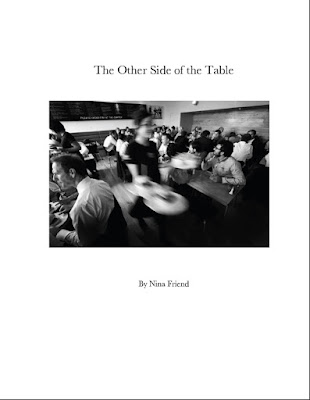
When Nina set out to write her honors thesis with me this year, we both knew that food would be involved, as well as Nina's passionate interest in the lives of those who serve. Over the course of many months, Nina went from restaurant to restaurant, from book to meeting, from interviews with famous people to serving herself. She wanted to see, as she writes in her thesis, beyond the performance. She wanted to know who was happy as they served—and when and why. She asked whether "serving others can coexist with serving oneself."

A supreme perfectionist, a writer who deeply cares, a young woman who asked for more and more critique—and who absorbed it, faithfully, returning each time with a thesis of ever greater grace and magnitude, Nina has gone behind the lines in her thesis—a work that will change its readers and remind them always (a perpetual nudge) to look harder at the person announcing the day's specials.

Nina, like David Marchino, whose thesis is featured here, has given me permission to share some of her work with you. I'm scurrying out of the way so that you can meet Nina and her cast of characters yourself. This is from the chapter called "Community."

Community

Crisp and golden, it’s propped in the middle of a silver platter that’s been in the family forever. A heap of crumbled bread forms a moat around the centerpiece. Stuck together with orange juice, flavored with parsley. The first cut slices the bird on its side. Succulent. Soft. A ladle filled with gravy. A spoonful of stuffing. Two helpings of pecan pie. Chocolate mousse. Whipped cream.

* * *

When Ellen Yin opened Fork Restaurant eighteen years ago, she wanted the
space to feel familial. The mosaic floor was laid down by a neighborhood tile guy. A local ironworker made the chandeliers. A fabric designer in the area crafted lampshades. Tony DeMelas says the restaurant instantly became “a community of artists and love.”
When Yin decided to revamp the restaurant in 2012, she called up Tony to create
a mural. Something to hang over the brown velvet couch that stretches across an entire
side of the restaurant. Tony was honored to be able to create something for the restaurant
he worked in.

When Tony was working on the mural, Chef Eli Kulp would drop by his studio.
Just to keep him company. Just to be there. “He was very hands-on,” Tony says. Kulp
was the only chef that has ever influenced Tony’s work. He was infatuated with the way
Kulp composed his plates. The way he could make a rib look like a log in the woods with
flowers blooming out of it and mushrooms growing from tiny cracks. His food was
sculpturesque. Tony says, “I’d look at [Eli’s plates] and go, ‘[If] you just blew this up and
abstracted it…and put it on a canvas, you could sell the hell out of this thing.’”

Tony’s mural hangs above the extra-long couch and reflects its color onto the
dark wood tables. Yellows and oranges and light greens and white and brown. A forest of
tree trunks, abstracted.

Tony used to walk past the painting hundreds of times every day as he hustled
from Fork’s kitchen to his tables, balancing plates in his arms. Customers would come in
and sit down and admire the mural. They would say things like, “Oh, it’s so much bigger
than in the pictures!” They would be waited on by Tony – with his square, tortoise-shell
glasses and eyes that feel like he’s staring into your soul – and they would have no idea
that the humble man taking their orders was the artist who painted that masterpiece.

* * *

Community can be built into a place. But it’s the people within that place who
decide whether community flourishes or dies.


Read more...

introducing David Marchino, a writer fully formed

Sunday, April 24, 2016

You have heard me speak of my two honors thesis students. Tuesdays we'd meet. Through the week we'd talk or write. Sometimes I'd see pages. Sometimes I'd wait for pages. Always I was here and they, my students, were where they had to be: sifting, thinking, wording, revising, making the story what it had to be.

David Marchino, the guy who taught me jawn and green hair, bamboo and patience, the healing power of a boyhood friendship, taught me even more than that with his memoir, He Will be Remembered: A Father's Crowded Life. In these tight, proud, poeming pages, David recalls the father he loved, lost, and recovered, if only for now. The cemeteries where the dead appease the living. The religion of his parents' cocaine. The power of a recovered briefcase. The voices of plead and promise. David speaks through namesakes. He tunnels through memory. He comes out the other side, burnishing truth with myth—the opposite, too.

David has given me permission to share the opening pages of his memoir with you. I do that here, with deepest respect for the journey David has taken and the words he has produced. With the greatest possible sense of honor that he allowed me to stand on the sidelines and cheer him on.

David Marchino. Writer. True.

From the (near) beginning:

He is not hard to find. He may arrive when you speak his name, or when you curse it. A magician whose default state is disappeared. His greatest trick is presence. My father—eight years gone—now back. Ta-da.

He looks worn, like he’s spent the last few years disappeared in a pothole. Like his body has finally exhausted its last expanses of youth. The man is tired. His arms, his legs, his skin. He’d been virile once, you could tell. I remembered how the skin tightened around his biceps, how he’d make the panther on his arm roar. He’d always been a little slight—not more than five-and-a-half feet—but now he looks unsteady.

“Hello, Sonny,” and I am fourteen again: his grip on the back of my neck, his prickly lip on mine. Love that said I have you.

When he hugs me, I want to say I feel that slip away. His blustery love, the years gone. But I only feel in my arms a man who has stagnated, and he, in his, a son he no longer knows.

He sits me on his couch. He lies to me. He paces the floor and sips beer after beer. “Only four a day now,” he says as his eyes grow rheumy and soft. Hustling is still a part of his to day-to-day, only now there is safety. He is a supplier, never out on the streets for more than fifteen minutes and raking in more cash than he’s ever seen. I don’t doubt this. For the past eight years, I’ve had no significant contact with my father, but he came sporadically every now and again. A phone call at two in the morning, a wet whiskey-rasped voice. The few times I heard my father cry. It was desperation. He’d been dealing and had cut someone short. Word got around. They’d put the gun in his mouth. They’d hit him with a bat. The shapeless, omnipotent they were on the hunt for him. He was going to die.

I’d cry with him during these calls—I’m not sure a son can do anything else in that situation. But, when he hung up and I was left with just the dial tone, I felt sure Dad would be okay. He wrote the story of his life, circumstances be damned. My father was legend, was myth, was Roman God. As long as someone believed in him, he could never be lost.

He asks about a lot, never sitting down with me. It’s as much interrogation as it is plea. Questions are fired off with no space given to answer them. They are formalities more than anything else. He does not want my answers. He prefers his own. He reads our reunion as permission to rewrite the past, prune the truth to his liking. It is the hand that gripped my neck as a child and directed me, as though it clutched the handles of a bicycle. It reaches out for the past eight years of my life.

It’s desperation, I realize. We fear the unknown—the late-night creaks that resound from the basement as we try to sink into bed, the voices we are certain we hear calling our name as we make our way through a soulless alley. That is true fear: incalculable, unreadable. As my father looks into my eyes after all these years, he sees it in me. I am a void wrapped in his orange-ish, freckled skin. I come to him a changeling, a severed connection he is frantically trying to reestablish. We fictionalize what we do not know—an admission of ignorance and an appeal for enlightenment. A construction meant to give shape to the unknown. The gentle blue of the sky draped over the endless, infinite, abyss of space. To fit my life into some predetermined mold is, for my father, a means to close the gap between us. He pretends to know his son. It is easier that way....
Tomorrow, the work of Nina Friend.

Read more...

Joan Wickersham in person, Kelly Writers House as refuge

Saturday, April 23, 2016

I would have preferred a sharper photo. I could blame my fatigue at the near end of that day—my hands slipping, or my eyes watering, or something. Instead, I'll declare this photograph of Joan Wickersham reading at Penn's Kelly Writers House to be infused by the light Joan carries with her. As she works. As she reads. As she considers. As she listens.

Joan was at Penn to read from three works—nonfiction (The Suicide Index), fiction (The News from Spain), and poetry (Vasa Pieces, parts of which appear in Agni 82). Her coming was, for me, a highlight of this semester—a chance to hear from a writer whose work has long inspired and thrilled me. A chance, too, thanks to Joan's invitation, to spend an hour or so alone with her over steeping, seeping cups of berry tea. We talked advertising youths, Lab Girl, place in memoir, the confounding role of adjunct teachers, Philadelphia then and now. I discovered, in Joan, that rare, wonderful thing: a person as gloriously complex and broadly thinking in person as she is on the page.

And then there she was, reading. Words I'd read twice, sometimes three times before, but delivered newly. A culminating sequence from Vasa Pieces—new work inspired by the sinking and resurrection of the Swedish warship, Vasa. Beautiful pieces made thrilling by their emergence from history and their threads of urgent now. The first poem setting the tone, revealing the "must" of this work—the role the Vasa played in the imagination of Joan's husband:

... I imagine you down there,
reading and re-reading the story of Vasa,
memorizing every picture, puzzling over the order—
the heeling ship, the sinking ship, the risen ship,
the sunken ship, the battered risen ship again—
clinging to the table leg, pretending it was a mast.
Poems continuing on through ships (and lives) gone wrong, through autobiographies redesigned by survivors, through shipworms and felt absence.

Until Joan lifted her head. And even then, her spell was not broken. The light still broke behind and through her.

I want to thank my students who attended for allowing this moment into their lives. I want to thank Jamie-Lee Josselyn, that lovely vision in green pants, for her beautiful introduction. I want to thank the Kelly Writers House for being home and hearth to both talent and soul, for being that place that students can and do turn to when the world feels raw and bright minds are the cure.

I want to thank Joan for the afternoon, and for the inspiration of her commitment to the work itself. The work, above and beyond all else.

Read more...

the moving spectacle of nonfiction, in Phillip Lopate's words, as the semester nears its end

Sunday, April 17, 2016

This past Wednesday afternoon and evening I had the distinct pleasure of spending time in the company of the great essayist and Columbia University professor (and head of the graduate nonfiction program), Phillip Lopate, his wife, his daughter, and members of the Bryn Mawr University creative writing program.

(Thank you, Cyndi Reeves and Daniel Torday, for allowing me to crash the party.)

Between the cracks of many deadlines here, I've been reading from the books I bought that evening. I have, of course, read Lopate through the years; who can teach nonfiction without owning Lopate volumes? But I did not own, until this Wednesday night, To Show and To Tell: The Craft of Literary Nonfiction, which is, in a word, a glory. Perhaps it is because I agree so steadily with Lopate's many helpful assertions, perhaps it is because I, in my own way, attempt to teach and, in books like Handling the Truth: On the Writing of Memoir, carry forward these ideals about the rounded I, the obligation to the universal, the curious mind, the trace-able pursuit of questions, that I sometimes read with tears in my eyes passages like this one, from "Reflection and Retrospection: A Pedagogic Mystery Story:"

In attempting any autobiographical prose, the writer knows what has happened—that is the great relief, one is given the story to begin with—but not necessarily what to make of it. It is like being handed a text in cuneiform: you have to translate, at first awkwardly, inexpertly, slowly, and uncertainly. To think on the page, retrospectively or otherwise, is, in the last analysis, difficult. But the writer's struggle to master that which initially may appear too hard to do, that which only the dead and the great seem to have pulled off with ease, is a moving spectacle in itself, and well worth the undertaking. 
There are just two more weeks left in this semester at Penn. My beautiful honors thesis students are finalizing their work and, soon, will not just hold their glorious books in their hands, but have the time to reflect back on all the lessons learned. My Creative Nonfiction students are writing letters, Coates and Parker and Rilke style, to those they feel must hear them, while also working on 600-word portraits of one another. Joan Wickersham, the extraordinary writer of both nonfiction and fiction is headed to our campus, Tuesday evening, 6 PM, Kelly Writers House—and if you are anywhere near, I strongly suggest you make the time. She is a national treasure.

Teaching is exhausting, exhilarating, necessary, confounding, essential. I learn that again, year upon year. I stagger away—made smarter, in so many ways, by the students I teach.


Read more...
The Leaving/Tara Altebrando: reflections by my student, Emma Connolly

Thursday, March 24, 2016


When I talk about my students at the University of Pennsylvania—when I speak of their commitment to our work and to our community, the quality of their search and the depth of their answers, their sentences on the page—I am reflecting on what I love best about the school that once educated and now employs me. I am looking past the rumors and gossip and seeing straight into the heart of young goodness.

Because that goodness resolutely lives.

This semester I have again been blessed by the company of young people and their great talent. A few of my students have brought to class not just an interest in poetry or memoir or fiction (or song writing, architecture, economics, rock climbing, medicine, you name it), but a specific interest in young adult literature—an interest that has been heightened by my uber-cool Penn colleague (and YA writer), Melissa Jensen. I've extended an invitation to any in the class to read from the library of new books that make their way to me—and to offer, here, their thoughts.

In this case, Emma Connolly—a young woman who practically defined memoir in her expectations essay, a young woman now looking ahead to a no-doubt stellar career (at least to start) as a middle grade teacher—took home my copy of Tara Altebrando's new and thrilling book, The Leaving (Bloomsbury, forthcoming). I'd blurbed the book for Tara. I wanted Emma's thoughts. Here, in Emma's words, is what The Leaving is all about.

You see what I mean about talent? Intelligence? Can you imagine Emma as the teacher she will be?

This is the Penn I love.

(And I love Tara, too.)

Who are you without your memories?
For the characters of Tara Altebrando’s engrossing, twisting, mysterious, “The Leaving,” this is not a hypothetical question. When five teenagers are dropped off in an abandoned playground eleven years after they went missing, they are celebrated and intensely questioned. Where were they? Who took them? And how can they be telling the truth that they don’t remember any of it?  
As Scarlett and Lucas, two victims of the event known as “The Leaving,” and Avery, the left-behind sister of the only victim who has not returned, try to solve their own history, Altebrando confronts questions of identity, family, and memory. When Scarlett returns home to a mother who has attributed her disappearance to alien activity, she can’t shake the feeling that they are the ones who are from different planets. What if you don’t fit in where you’re supposed to? Lucas is disturbed by the discovery of skills that he must have learned during his absence. Can you be afraid of your past self? Meanwhile, Avery watches their return unfold as she continues to deal with the devastation that her brother’s disappearance has had on her family. Would she be better off like the victims of the “The Leaving,” able to essentially skip over a difficult childhood?
The characters discover unfinished leads from passed-away relatives and potential clues from past selves. They chase after jerkily recovered blips of memory that Altebrando visually represents by scattering words all over the page and interrupting the narrative with blocks of remembered images. With each revelation, we are drawn deeper into the search for answers before being thwarted yet again. Each time the story approaches acceptance of the fact that one might simply be better off not remembering, though, Altebrando reminds us, “Forgetting meant not knowing, meant ignorance, meant maybe making the same mistakes again and again.” So we keep searching, unable to leave this book until the very last page.

Read more...

The Home Collection/Looking Ahead to the Beltran Family Teaching Award Evening

Thursday, February 4, 2016

In the early hours of this morning, I've been reviewing the final submissions to the Beltran Family Teaching Award chapbook—a collection of reflections on home by Penn students past and present; featured guests A.S. King, Rahna Reiko Rizzuto, and Margo Rabb; and the leaders of Penn's Kelly Writers House.

Trust me, please. The words (and images) are stellar and binding. No piece remotely resembles another. Each reveals and, in ways both quiet and surprising, sears.

I have crazy ideas, that is true.

But when those who join us that evening—March 1, 6 PM, Kelly Writers House, all are welcome—hold this chapbook in their hands and hear our guests and look out upon these faces, this particular craziness will not seem so very crazy at all.

Because it's them.

And they have spoken.

A huge thank you to my generous husband, who has spent untold hours by my side, laying out these pages.

Read more...

here you begin (today at Penn, with Dillard and Didion)

Tuesday, January 26, 2016

Annie Dillard and Joan Didion will be our guides today in English 135. Voice and meaning will be our quest. We'll consider, for a moment, these two sentiments.

Can both be true?


“Why do you never find anything written about that idiosyncratic thought you advert to, about your fascination with something no one else understands? Because it is up to you. There is something you find interesting, for a reason hard to explain. It is hard to explain because you have never read it on any page; there you begin. You were made and set here to give voice to this, your own astonishment." — Annie Dillard, “Write Till You Drop”

And from this:

"We are all brought up in the ethic that others, any others, all others, are by definition more interesting than ourselves; taught to be diffident, just this side of self-effacing... Only the young and very old may recount their dreams at breakfast, dwell upon self, interrupt with memories of beach picnics and favorite Liberty lawn dresses and the rainbow trout in a creak near Colorado Springs. The rest of us are expected, rightly, to affect absorption in other people's favorite dresses, other people's trout."— Joan Didion, "On Keeping a Notebook" 


Read more...

the new semester begins at Penn with an Adele hello

Tuesday, January 19, 2016

Sometimes, as the first day of a new semester begins at Penn, I think of how very close I came to saying no to this opportunity all those years ago.

It would have been one of the greatest mistakes of my life.

And so, again, on this bitter cold day, we begin. We're focused on home this semester. We're reading Annie Dillard's An American Childhood, George Hodgman's Bettyville, and Ta-Nahesi Coates's Between the World and Me, not to mention John Hough on dialogue and countless excerpts (countless as of now, anyway, because I can never tell what's going to inspire me before and during class). We'll be tapping into the new Wexler Studio—recording some of our work. We'll be laying the groundwork for the Beltran evening on March 1—all invited—during which time we'll be visited by my writing friends (and worldly talents) Reiko Rizzuto, A.S. King, and Margo Rabb. We'll hear from former students. We'll write letters to the people in our lives, in Mary-Louise Parker and Ta-Nahesi style.

And today, if all the machines are working, we'll start out with this.

I can't tell you why or how we'll use it.

You'll just have to imagine.

Meanwhile, before any of that, I get to share an hour with Nina and David, who will be writing their theses with me.

How lucky I am.

Read more...

Home is where the art is: a new essay in Chicago Tribune

Friday, January 8, 2016

I've been working out ideas about home and literature, literature and home for awhile now, and on March 1, accompanied by friends A.S. King, Reiko Rizzuto, and Margo Rabb, my colleagues at Penn, and students past and present, I'll be doing even more thinking about the topic for the Beltran Family Teaching Award event at the Kelly Writers House at Penn.

My newest thinking is here, in this weekend's Chicago Tribune (Printers Row), with thanks to Jennifer Day, Joyce Hinnefeld, and Debbie Levy, upon whom I seem to first try out my ideas. (Oh, Debbie, you're a gift.)

To read the whole story, go here.

Read more...

my wide-ranging conversation with Buzz Bissinger, at Kelly Writers House

Monday, November 16, 2015

On Homecoming Saturday, in the Kelly Writers House on the Penn campus, I spent 75 minutes in conversation with Buzz Bissinger. It was a dialogue of many dimensions and much quiet—and authentic—self reflection.

That conversation can now be watched in its entirety here.

Read more...

cures for literary heartbreak

Thursday, November 5, 2015

Look for me behind stacks of books. That's where I'm living lately.

Assembling the content for a traveling multi-day memoir workshop. Preparing to teach the personal essay during a morning/afternoon at a Frenchtown high school. Knitting together ideas for a four-hour Sunday memoir workshop, next weekend, at the Rat (also in Frenchtown; places still available). Conjuring poem-engendering exercises for the fourth and fifth graders of North Philly. Building the syllabus for my next semester of teaching at Penn. Putting more touches onto the Beltran Family Teaching Award event at Penn next spring (featuring Rahna Reiko Rizzuto, Margo Rabb, and A.S. King). Re-reading Buzz Bissinger so that I can introduce and then publicly converse with him at the Kelly Writers House this Saturday, for Penn's Homecoming. Talking to Jennie Nash about an online memoir workshop. Writing the talk I'll give this evening to kick off the LOVE event (featuring film students and Philadelphians) at the Ambler theater.

My writing (my novels) sit in a corner over there, where they have sat for most of this year. I'm sunk deep into the pages of other people's work. Their stories, their sentences, their churn: a thrilling habitation.

Every time I feel frustrated by a sense of career stall or perpetual overlook, I remember this: There are writers—truly great writers—who have gone before me, who have written more wisely, who have seen more clearly. I may want to be noticed, I may hope to be seen, I may wish to be important, a priority, first on a list, but honestly? Why waste time worrying all that when there is so much to be learned—about literature, about life—from the writers who have gone before—and ahead—of me.

James Agee. Annie Dillard. Eudora Welty. We could stop right there. Read all they've written. Make the study of them the year we live and it would be enough. It would be time well spent, time spent growing, time during which we learn again that aspiration must, in the end, be contextual. We can't hope to stand on a mountain's top if we don't acknowledge all the boulders and the trees and the ascent and the views that rumble beneath the peak.

My cure for my own sometimes literary heartbreak: Sink deep inside the work of others. Recall what greatness is.


Read more...

  © Blogger templates Newspaper II by Ourblogtemplates.com 2008

Back to TOP