Showing posts with label Chloe Aridjis. Show all posts

On reading OUTLINE by Rachel Cusk, and thoughts on a new generation of scouring fiction

Monday, January 19, 2015

Chloe Aridjis, Jenny Offill, Samantha Harvey, Catherine Lacey, Rachel Cusk: Lately I've been reading authors like these, women unafraid of breaking form or muddying expectations, women writing sentences that scour. They are books in which the characters choose, in some way, to be alone—to isolate themselves inside their own thoughts, to sever themselves from social conventions, to tell stories that, without resort to war or torture, somehow carry knives.

This morning I finished reading Outline, Rachel Cusk's story of—well—what is it, exactly? It is the story of a writer who has gone to Greece for a week to teach; yes, it is that, at one level. But mostly it is about a woman who moves through the world under the assault of other people's stories. People who find themselves, in her presence, talking through the cyclone of their own lives, presenting themselves as they wish to be presented, asserting their right (right?) to be heard, smudging and aggrandizing, begging to be understood, until, ultimately, their stories devolve into self-circling harangues. The people our narrator meets, the people who natter on, hardly need to be encouraged. Given room to talk, they do, exhibiting, ultimately, that something selfish, stingy, mean of propulsive monologue. We have all been on the other side of such a thing. We understand. There is almost a comedy to it.

But Cusk is after far more than a set piece, a commentary on rampant self-absorption. Cusk ratchets the ambush of monologue to high tension in Outline. She makes, of these disconnected interludes, a story with an arc. She uses her scheme to explore essential questions about the lies we tell ourselves, the responsibilities we negate, the desire we have to blame other people for the unhappiness we feel or the success we have not had or the mess we have made of marriages or parenting. Her narrator is a woman who "did not, any longer, want to persuade anyone of anything." She is a woman rarely asked about herself, but when she does comment on the stories she is told, she brings an outsiderly wisdom, a pausing perhaps. We know the outlines of who she is (a writer, a divorcee), in other words, but far more important is how we come to know what she thinks.

Here, for example, she is responding to an insufferable woman's complaints about marriage:

I replied that I wasn't sure it was possible, in marriage, to know what you actually were, or indeed to separate what you were from what you had become through the other person. I thought the whole idea of a 'real' self might be illusory: you might feel, in other words, as though there were some separate, autonomous self within you, but perhaps that self didn't actually exist. My mother once admitted, I said, that she used to be desperate for us to leave the house for school, but that once we'd gone she had no idea what to do with herself and wished that we would come back.

Here the narrator muses on desire:

I said that, on the contrary, I had come to believe more and more in the virtues of passivity, and of living a life as unmarked by self-will as possible. One could make almost anything happen, if one tried hard enough, but the trying—it seemed to me—was almost always a sign that one was crossing the currents, was forcing events in a direction they did not naturally want to go, and though you might argue that nothing could ever be accomplished without going against nature to some extent, the artificiality of that vision and its consequences had become—to put it bluntly—anathema to me. There was a great difference, I said, between the things I wanted and the things I could apparently have, and until I had finally and forever made my peace with that, I had decided to want nothing at all.
A rosy world view this is not. Easy entertainment—it's not that, either. But it is fierce and different and part of a new world order in fiction written by women. A movement to which I think we must pay quite close attention.


Read more...

Landscaping our prose (Virginia Pye, Vaddey Ratner, Chloe Aridjis)

Tuesday, February 11, 2014

Today (among so many other things) we're talking about landscape in memoir, about the ways that topography and visual detail elevate and suggest a story. We've read two chapters in Howard Norman's I Hate to Leave This Beautiful Place. We've written responses. And now we'll talk.

I'm going to be sharing these three very different approaches to landscape (each drawn from novels). I now share them with you. What do you learn from them? What do they teach you about possibilities?

First, from the courageous first novel (River of Dust) from the dear Virginia Pye, this evocation of a dusty province in China, 100 years ago:

On springtime mornings like those, when the rain had finally stopped, they waded out toward the creek that had been rising for days. From farms upstream floated all manner of tires, cut logs, old boots, and once a bloated cow, swirling in an eddy until it was skewered by the limbs of a fallen tree.

Now a snatch of London from Asunder, by the amazing Chloe Aridjis:

The dusk of Millbank had filled with the amber lozenges of unoccupied black cabs, miners with lantern-strapped foreheads rushing towards or away from the city centre, as I made my way to meet Daniel at the Drunken Duck, a pub a few streets from Tate Britain.

And now from my friend, Vaddey Ratner—words originating from Cambodia, from the deservedly bestselling In the Shadow of the Banyan:

In the courtyard something stirred. I peered down and saw Old Boy come out to water the gardens. He walked like a shadow; his steps made no sound. He picked up the hose and filled the lotus pond until the water flowed over the rim. He sprayed the gardenias and orchids. He sprinkled the jasmines. He trimmed the torch gingers and gathered their red flame-like blossoms into a bouquet, which he tied with a piece of vine and then set aside, as he continued working. Butterflies of all colors hovered around him as if he were a tree stalk and his straw hat a giant yellow blossom.


Read more...

Asunder/Chloe Aridjis: Reflections (and a celebration of Lauren Wein)

Sunday, May 26, 2013


Long-time readers of this blog may well remember the day I found and fell in love with Chloe Aridjis's first novel, Book of Clouds. It was a penetrable strange. It vibed mystique. It was Berlin wrapped in the gauze of supernatural weather and smoldering Hitler fumes.

Book of Clouds served as a reminder that novels don't need a category—or easy flap copy—to succeed. It also introduced me to the book's editor, Lauren Wein, whose books have consistently thrilled me and whose friendship is one those things I treasure most in my writing life. I profiled Lauren here, in Publishing Perspectives. She has a remarkable vision and a portfolio of edited books that is essentially unrivaled in the adult publishing world. She chooses, edits, fights for, and nurtures the unobvious—the sort of stories that many a mainstream editor overlooks, the sort of titles that go on to win prizes. (Book of Clouds won the Prix du Premier Roman Etranger in France.) Lauren's titles are written by authors who take their time, who fold in and across multiple themes, who have something to say. Novels as saturations. Novels as spills of the imagination.

Last week, Lauren sent me two of her newest titles, one of which was Asunder, Aridjis's second book. Already released in the United Kingdom, boxed with a star from Publishers Weekly ("stunningly good novel," they called it, also "brilliant"), Asunder is even better than Clouds—more self assured, more seductively strange, more cohering. I read it in a day, my breath held, my thoughts streaming: Can she pull this off, she is pulling this off, she has pulled this off, until I closed the book and pumped my fist, victory style. Chloe Aridjis wields enormous intelligence and knowing in this story about an art museum guard named Marie. She folds history in—a 1914 attack on a Velazquez painting by an angry suffragette. She teaches craquelure—the slow decomposition of paintings over time. She studies the art one might make and hold and the art one must never touch. She creates distance and broaches it. She yields men and women together, and apart. She writes magnificently, like this:
After we'd made ourselves a quick cup of tea from a little tray, we set out. By then dusk had turned into an empty-handed magician who kept a few paces ahead of us, snuffing out the streets seconds before we reached them, robbing us of the sights we'd come to see. One by one, the lights in shop windows were switched off, cafe tables and chairs brought in, postcard racks folded up. 
Look, I loved this book. What more can I say?

Asunder is due out in September from Houghton Mifflin Harcourt.

Read more...

The Devon Horse Show returns, in this weekend's Inquirer

Saturday, May 25, 2013


In which I write of my long love for this show, my gratitude for clop and bray.

I'll be posting photos of the show on this blog in the days to come.

I will also be posting news of an incredible new novel—Asunder, by Chloe Aridjis—due out this September and edited by the magical Lauren Wein. Look for my thoughts on this glorious work of art tomorrow.

Read more...

On Berlin, Re-reading, and Book of Clouds

Friday, December 9, 2011

David Bowman has an interesting and timely back-page essay in The New York Times Book Review this weekend.  It's called "Read It Again, Sam," and it celebrates books fine enough to be read again.  Patti Smith reports on her plan to read again An Episode in the Life of a Landscape Painter.  Stephen King professes to having read Lord of the Flies eight or nine times.  Bharati Mukherjee reveals that she re-read all of Louise May Alcott at least a half-dozen times at the tender age of 9.

And you?

Earlier this week, while on a plane home from London, I reached for Book of Clouds (Chloe Aridjis), a book I'd read at once upon its release in 2009.  It's just the right size for an eight-hour flight (with a nap tucked somewhere in between), and I'd wanted to re-read it because I craved the surreal mood it had engendered within me—the fog, the mist, the strange; I craved the Berlin at the book's heart.  How had Aridjis achieved her effects?  I would examine this.  I would study it.

I had remembered Clouds as a lyric of a book, and indeed extraordinarily beautiful images float throughout. But what was also fascinating to me, upon my second review, is that Aridjis is not tricking her reader with language here; she is never overreaching.  Indeed, some of her oddest moments and most surreal, memorable constructions are rendered with thoroughly uncluttered, even straightforward prose—a glorious effect that I had not deconstructed my first time through.  So caught up was I in the mood of her Berlin—in the underground worlds, in the residues of a sinister past—that I failed to see that passages like this one, describing an abandoned bowling alley beneath the streets, had been meticulously and not (until the very end) metaphorically put forth.  Aridjis gives us the facts.  She lets us do with them what we will. 

After traversing several dark, damp rooms, plowing ever deeper into the labyrinth, though it was hard to tell how many doorways we'd actually crossed, we arrived at the so-called Gestapo bowling alley, a rectangular room, somewhat larger than the others as far as I could tell.  Our guide asked us to fan out so that everyone could see and directed his flashlight at different spots.  I stepped out from behind a girl with pigtails and began to look around.  It was a pretty chilling sight.  Everything, it seemed, was just the way it had been left decades ago.  At the center of the room lay a metal contraption, about eight feet long, an obsolete machine once used for spitting out wooden bowling balls, and with its rusty corners and thin bars, it looked, at least from afar, like a medieval instrument of torture, like those racks to which victims were bound by their hands and feet and then stretched.

I would not have known this about Clouds had I not read the book a second time.  I would have carried with me a false idea about Aridjis method—a first-blush idea, not a studied one.  I loved the book even more the second time I read it through.  I loved it, though, for somewhat different reasons.

Always, in perpetuity, Clouds will be a signifier for me—a book that in large part sent me to Berlin this past summer, a trip that subsequently led to my own work on a new (and very different) book set in that city for the beautiful Tamra Tuller of Philomel.  Without Clouds, I would not have taken that trip, in other words.  Without Clouds, I would not now be sitting here, surrounded by books and films about Berlin's past.  This was a book that had deserved a second reading.  Most good books do.

Read more...

On Short Novels, The Sense of an Ending, and Julian Barnes

Monday, October 31, 2011

The pages of my copy of The Sense of an Ending, the gripping new novel by Julian Barnes, had not been cut.  I had to slip my finger in between each one as I lay reading at the close of a snowy weekend.  This pleased me greatly.  The feel of the paper against my skin.  The sound of a story unfolding.

I am always confused by critics of the short novel—by those who refer to the shorter novel as something lesser than.  I remember a conversation with Alice McDermott (Charming Billy, That Night, At Weddings and Wakes), in which she spoke of writing the kind of stories she herself liked to read—shorter and more compact novels, densified worlds, intimate places, landscapes of measured, studied sentences.

Yes.  Me, too.  The short novel may or may not be about plot, may or may not be commercial (whatever that is).  But when it is handled with the intelligence of an Alice McDermott or a Julian Barnes or a Julia Otsuka or a Kate Chopin or a Michael Ondaatje (Coming Through Slaughter) or a Chloe Aridjis or a Kathryn Davis or an Anne Enright, for example, I personally think there is nothing finer.  Brilliant short novels have the impact of poems.  They are, most often, shorter precisely because the writer has taken the time to banish the extraneous and diluting, the self-aggrandizing or -indulgent.  There is a story to be told.  There is its core and there are those things essential to its core.  The brilliant writer of shorter novels holds that line, maintains his or her focus, goes blessedly deep, does not skip from this event to that—indeed, does not concentrate on "events" at all.  Character and meaning, language and symbol, the ripe stuff.  Brilliant short novels concentrate, primarily, on that.

I know many who would disagree, and that's the beauty of this literary community—the possibility of conversation, dissension.  (And of course I have many beloved books on my shelf that run past 300 pages, though I will admit that I don't have many favorites that run past 400.)  But I hope no one will disagree with me about this new book by Julian Barnes.  From the first sentence to the last I hardly exhaled.  The entire book was of such a piece that I felt certain that Barnes himself was sitting here, telling this story about a man, Tony Webster, resorting the memories of his youth.  Webster had thought himself a regular-enough student with a regular-enough first love affair.  He had gotten on with his life and lived it reasonably well.  But when he learns that he has been remembered in a will in an odd and oddly disturbing way, and when, over time, he is presented with evidence of who he really was as a young man, he is staggered in the way that we all are staggered when presented with contradictions of our own fine self-opinion.

Barnes, whose Nothing to Be Frightened Of, is a fine and teachable book of nonfiction, puts his philosophical genius on full display in this novel, his great capacity for going deep.  One example of many:

And so, for the first time, I began to feel a more general remorse—a feeling somewhat between self-pity and self-hatred—about my whole life.  All of it.  I had lost the friends of my youth.  I had lost the love of my wife.  I had abandoned the ambitions I had entertained.  I had wanted life not to bother me too much, and had succeeded—and how pitiful that was.
He also demonstrates his talent for plotting (yes, short novels have plots, too—it's just not what drives them), for surprise, for mystery, even.  The Sense of an Ending is a rich story, a riveting one.  If you haven't yet encountered Barnes, I suggest you start with this.

Read more...

Going Home: Ein Konzert fur die Berliner Domstiftung

Sunday, June 19, 2011


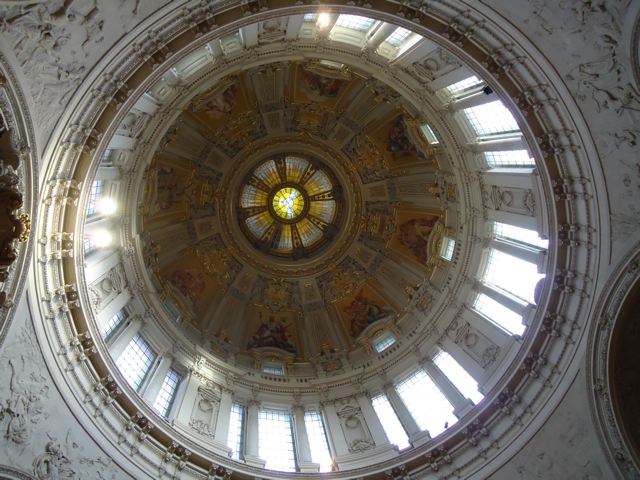
We spent the final evening not as tourists but as audience within the Berliner Dom. The thirty members of the Berliner Domkantorei gathered, to begin, at the back of this cathedral, lifting their voices up, then moved progressively and finally en masse toward the altar. The Berliner Domblaser, a brass ensemble, answered their song. The organ responded. It was eight in the evening, and we were far from that crowd, beneath that magnificent dome, unbothered by the worldly silences or professional frustrations we did manage to leave entirely at home.

Nothing bothered me here. All was new, an invitation. I leave Berlin with a fuller understanding of a devastating regime, a great respect for a city's ability and willingness to rebuild, a broader alignment with architecture both restorative and radical, and a love for the gentle grunge and craftsmanship of a proliferated artist community.

The skies, by the way, are exactly as Chloe Aridjis describes in her evocative and powerful slender novel, The Book of Clouds, which led me, like the great historian and writer Paul Steege led me, like my friend Tamra led me, to this city.

It had been a long time since I traveled like this. I am different than I was, and different than I will no doubt now be.

Thanks for journeying with me.


Read more...

How do you choose the books you are going to read? she asked

Saturday, July 17, 2010

A few days ago, when Amy Riley and I were taking a wee break from techno talk (Beth:  HTML code?  Amy (long distance):  Okay.  I'm doing it with you.  Are you on the Feedburner screen?  Do you see the box next to the words ....?), I told her that I'd just returned from the bookstore with an armload of new books.  She, being a great reader herself, asked me which ones.  I listed Libba Bray's A Great and Terrible Beauty, Richard Russo's That Old Cape Magic, Maile Meloy's Both Ways is the Only Way I Want It, John Green's Looking for Alaska, and Jane Mendelsohn's American Music.

There was a bit of a pause, as Amy searched (I imagine) for some pattern in my selections.  "Interesting," she said at last.  "How do you choose what you are going to read?"

In answering the question I realized just how many influences weigh upon me.  The fact that I work in multiple genres, that I teach, and that I care a whole lot about language has me scurrying after the books I hope will teach me—in every genre.  The fact that I sometimes wonder why the rest of the world reads what it reads (e.g., The Help, Girl in Translation, Loving Frank) gets me curious enough to buy.  Blogs influence me (hence my purchase of My Name is Mary Sutter).  Friends do (Kate Moses has led me to The Names of Things; Jane Satterfield to The Importance of Music to Girls).  Reviews do (The New York Times Book Review led me to Forest Gander's As a Friend, Kim Echlin's The Disappeared, and Chloe Aridjis's Book of Clouds).  I trust imprints, like Graywolf, because they publish friends like Alyson Hagy and so I read and not surprisingly love Jessica Francis Kane's The Report.  I trust editor friends like Laura Geringer, Jill Santopolo, and Alane Mason, and so I read, respectively, Virgin Territory, Between Shades of Gray, and Aliens in the Prime of Their Lives and Nothing Happened and Then it Did.  Many, many authors send me their books, and I do all I can to read them.  On lovely afternoons, I drift through bookstores and find titles that appeal, and some of my favorite books have come to me this way:  Michael Ondaatje's work, The Book Thief, The Cellist of Sarajevo, to name just a few.

This time around, my reasons were thus:  Maile Meloy because my writing friends adore her work and because I've been impressed by earlier stories.  John Green because he is John Green.  Richard Russo because I always meant to read him and because bloggers I respect insist.  Libba Bray because two minutes in her presence and I adored her.  Jane Mendelsohn because I absolutely loved her first novel, I Was Amelia Earhart, which begins: "The sky is flesh. The great blue belly arches up above the water and bends behind the line of the horizon...."

Marketers would love to know the why behind book selling.  Pundits speculate (interestingly, following the recent New York Times story suggesting that book trailers are highly influential, my in box was full of readers saying they never watch trailers).  I can only tell you what I do.  I wonder what your methods are.

Read more...

Book of Clouds: A blog review about a book that takes risks

Saturday, April 11, 2009

Wearied by an overwhelm of work and the static panic of good-news hoping, I had again let reading go, until yesterday, when I brought home Book of Clouds (Chloe Aridjis), The Frozen Thames (Helen Humphreys), and The Cradle (Patrick Somerville). This morning through just now I read the first, a book about which Wendy Lesser, in the New York Times Book Review, recently wrote: "First novels by young writers who see the world with a fresh, original vision and write about it with clarity and restraint are rare enough to begin with. When you add in the fact that Chloe Aridjis’ 'Book of Clouds' is also a stunningly accurate portrait of Berlin, as well as a thoughtful portrayal of a young Mexican Jew drifting through her life abroad, this novel becomes required reading of the most pleasurable sort."

I love fresh and original. I love a writer who will take risks. I adore publishers who will take those risks, right along with the writer—who will agree to put out a novella-length book as a classy paperback original in a format that fits so perfectly into one's hand that nothing—even that overwhelm of work—can budge the reader once she has turned the first page.

What a perfectly odd, summation-defying book this is. What a lonesome character is Tatiana, who believes she sees Hitler on the subway dressed as an old woman, who hears phantoms in the unrented room above her, who meets a meterologist and learns the language and salvation of clouds, and whose job involves transcribing the dictations of an historian who may or may not be a transvestite, and who may or may not be relevant. Do books about lonely people have sustainable plots? It's an old debate; let the debaters read this book. Let them fall into the quick thick of clouds and fog and watch this author lasso weather.

A thick smell hung in the air, a smell that spoke of dungeon, as if one thousand Victorian chimneys had been tipped over and the lethal combination of coal fires and urban vapor had been decanted into the vast cavities of Berlin, crawling up walls and skimming the surface of the Spree, coating the shell of the S-Bahn and halting trains midjourney.

If that isn't enough for some in a book, it is more than enough for me. We can't ever know, just as this character never knows, if all she sees and hears actually exists. But what does actually matter in a book of fiction? Only the imagination does.

Read more...

  © Blogger templates Newspaper II by Ourblogtemplates.com 2008

Back to TOP