Showing posts with label Paul Steege. Show all posts

Scenes across the Berlin Wall, and a story about female graffiti artists, with thanks to Paul Steege

Wednesday, May 28, 2014


There is no sound in this video shot across the Berlin Wall in 1971. There doesn't have to be. The faces here say it all, the blown kisses, the raised binoculars, the East Germans who do not wish to leave the friends they spot in the West across the many walls, the many divisions.

This is chilling, heartbreaking, telling, historic, and I have my friend Paul Steege, writer and historian at Villanova University, to thank for sharing it with me.

Paul also sent along a link to this Julia Baird New York Times story about the rise of female graffiti artists around the world, which ran earlier this week. The story is fascinating, end to end, and begins like this:

For decades it was thought that the reason street art was almost exclusively male was because men were more comfortable with peril; many sought it. After all, street art is notoriously dangerous, exhilarating and risky.

It is, of course, usually illegal; many street artists work at night, in wigs or masks, wearing shoes made for running. One night, when the Australian artist Vexta, who is now based in Brooklyn, was painting neon-splattered, psychedelic images in an abandoned building with friends, the police arrived. She jumped through a hole in the wall, rolled under a shutter door and ran down the street to hail a cab. No one would pick her up, since she was smeared with dirt and paint.
 Ada, I think, as I read. Ada (Going Over). She might have been Vexta. She might still be.

Read more...

Honoring my mother at Villanova, and how I came to own three copies of Colum McCann's novel, Transatlantic

Wednesday, October 9, 2013


We honored my mother last evening at Villanova University—the Lore Kephart '86 Distinguished Historians Lecture Series being one of my father's lasting gifts in her memory. Ray Takeyh, PhD, Senior Fellow for Middle Eastern Studies, Council on Foreign Relations, spoke brilliantly (and with appreciated sparks of humor) on "Iran in Transition." An early meal with Paul Rosier, who chairs Villanova University's History Department, Paul Steege, who helped identify Dr. Takeyh as a speaker, the wonderful Reverend Kail Ellis, and so many special Villanovans got the evening off to a fabulous start. My sister came with her dear daughter Claire. My blue-eyed brother arrived and entertained. My father wore one of his many beautiful ties and was the elegant man that he is.

And then there was the moment, early on, when Father Peter M. Donohue, the charismatic president of Villanova, mentioned that there was a certain writer also in the house last evening at Connelly Center. An Irishman, he said.

Not Colum McCann, I said.

Yes. Colum McCann, he said.

A raised eyebrow. A rapidly beating heart. A blurt: Colum McCann is my third favorite writer, I said.

Which would sound like a compliment to anyone who has seen the hundreds upon hundreds upon hundreds of books in my house. There's a lot of competition. Only Michael Ondaatje and Alice McDermott stand above.

I had read McCann's newest, Transatlantic, the week it came out, and had written of it here. That didn't matter. A young man named Daniel disappeared and returned with a copy of the novel, signed Colum McCann. Later, Father Peter himself greeted me with a second copy of the book, this time signed specifically to me.

I told him he is your third favorite writer, Father Pete said.

You didn't, I said.

Oh yes I did.

A good man never lies. A good reader should never rank.

Thank you to Villanova University, Father Pete, Reverend Ellis, Paul Rosier, Paul Steege, Diane Brocchi, Ray Takeyh, and everyone else who made last night a success. Thank you to my father for having this idea in the first place.

And special thanks to Elizabeth Mosier, Chris Mills, and Nazie Dana, who made the night even more glorious.


Read more...

Jill Lepore: The Prodigal Daughter

Tuesday, July 9, 2013

Each year, for the Lore Kephart '86 Distinguished Historians Lecture Series, a group of faithful Villanova University scholars (including my good friend Paul Steege) work with my father to choose a speaker who will engage the Villanova students, faculty, and greater community. In 2011, that speaker was Jill Lepore, whose work I have always admired and whose presentation on Jane Franklin, Benjamin Franklin's sister, was exquisite. Jill was working on a book, she'd told us. What a great a book we knew it would be.

In this week's New Yorker, Jill Lepore contributes an essay titled "The Prodigal Daughter" that interleaves her research on Jane Franklin with her own growing up with a mother who was primed for beauty and who insisted that Jill go out and embrace the world. It is the most personal essay I've ever read by Lepore—and, by far, the most wrenching. It bears reading by any writer seeking proof of how the personal can elevate the historical, and how history bears on the present day. The final paragraph of Lepore's essay made me weep, literally. But let me share here the place where it all begins:
In the trunk of her car, my mother used to keep a collapsible easel, a clutch of brushes, a little wooden case stocked with tubes of paint, and, tucked into the spare-tire well, one of my father's old, tobacco-stained shirts, for a smock. She'd be out running errands, see something wonderful, pull over, and pop the trunk. I never knew anyone better prepared to meet with beauty.
And later—a passage I remember well from Lepore's 2011 talk:
He ran away in 1723, when he was seventeen and she was eleven. The day he turned twenty-one, he wrote her a letter—she was fourteen—beginning a correspondence that would last until his death. (He wrote more letters to her than he wrote to anyone else.) He became a printer, a philosopher, and a statesman. She became a wife, a mother, and a widow. He signed the Declaration of Independence, the Treaty of Paris, and the Constitution. She strained to form the letters of her name.
Lepore's new volume, Book of Ages: The Life and Opinions of Jane Franklin, is set for publication in October. My mother would have loved Jill Lepore. If you don't already love her,  you will after reading "The Prodigal Daughter."

Read more...

Jill Lepore and the electrifying evening

Wednesday, December 7, 2011

I'd like to use the word "electrifying" in the following post.  I'd like to use it several times.

Because that's the word that kept coming to mind throughout our time with Jill Lepore, who last evening graced Villanova University as the third speaker in The Lore Kephart '86 Distinguished Historians Lecture Series.  If I had allowed myself to wonder, theoretically, how one young woman could have already achieved so much in life—she's a professor of American History at Harvard and one of my very favorite writers at The New Yorker; she's published books on topics ranging from the Tea Party to the origins of American identity; she's gone to Dickens camp and read 38 volumes of original Ben Franklin; her work has won the Bancroft Prize and been a finalist for the Pulitzer; she's even co-authored a novel—I stopped wondering two minutes after she walked into the room.  The answer is pretty basic, pretty simple:  Jill Lepore doesn't waste an ounce of her intellect on posturing or presumption.  Her enthusiasm is equal to her intelligence.  Her facility with language, structure, theme is all in rather happy accordance with her capacity to sleuth her way toward truth.

She was extraordinary last night.  She was—here it comes—electrifying as she spoke about Jane Franklin, Ben Franklin's sister and truest correspondent (for more on the topic, please click here).  My mother would have loved Jill Lepore.  She would have sat there as I sat there, on the edge of a seat in a crowded room, happy to be in the company of one that exhilarating, that engaged. 

There are so many who make an event like this happen.  I'm particularly grateful to my friend Paul Steege, a Villanova University associate professor of history who sits on the speaker selection committee, to Diane Brocchi, to Father Kail Ellis, to Marc Gallicchio, and to Adele Lindenmeyr.  And of course, none of this would be possible without my father, Horace Kephart, who had the foresight to create this lecture series in memory of the woman he loved. 

Read more...

Jill Lepore to Headline the Third Annual Lore Kephart Distinguished Historians Lecture

Tuesday, September 6, 2011

A week or so ago, when my husband and I were powerless, my father called and invited us to dinner at his home, where my mother's orchids still grow, the figurines still shine, and the sun yet goldens the rooms.  Glimmers of my mother, all.  We were almost finished with this delightful repast (cloth napkins! dimmed lights! smart vegetables! organic cookies!) when my father mentioned that the Villanova University committee entrusted with the selection of a scholar for the Lore Kephart Distinguished Historians Lecture Series had made its decision, and that Jill Lepore was slated to come.  She follows Pulitzer Prize winning James McPherson and the utterly engaging Andrew Bacevich  in this role, and she will appear at the university on the evening of December 6th, details to come.

Jill Lepore happens to be one of my idols. She's not just the David Woods Kemper '41 Professor of American History at Harvard University and a staff writer for The New Yorker.  She's a woman who smiles warmly back at you from her portrait photos, despite the fact that her head is preposterously full of stuff about Charles Dickens and the Constitution, Benjamin Franklin's youngest sister and the Tea Party, eighteenth-century Manhattan and the King Philip's War (she has written or is writing books about it all).  For an apparent change of pace, she's even co-authored a widely acclaimed novel called Blindspot.  And once she wrote a New Yorker piece called "The Lion and the Mouse" (about E.B. White, Stuart Little, and the sometimes ridiculously short-sighted nature of critics and publishing houses) that was so letter perfect I didn't just blog about it here.  I wrote Ms. Lepore a gushing fan letter.  Miraculously, Ms. Lepore wrote back. 

Jill Lepore will be talking about the Tea Party and the Constitution in December.  I'll be providing more details as I can.  For now I'm simply expressing my excitement that my mother and father are working together once again to bring all of us something grander than grand.

My thanks to Paul Steege, a good friend, fine teacher, smart writer, and great soul, who remains a key member of this selection committee.

Read more...

Going Home: Ein Konzert fur die Berliner Domstiftung

Sunday, June 19, 2011


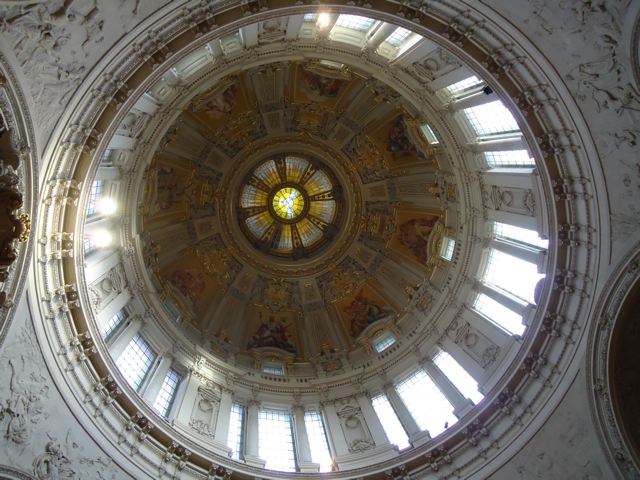
We spent the final evening not as tourists but as audience within the Berliner Dom. The thirty members of the Berliner Domkantorei gathered, to begin, at the back of this cathedral, lifting their voices up, then moved progressively and finally en masse toward the altar. The Berliner Domblaser, a brass ensemble, answered their song. The organ responded. It was eight in the evening, and we were far from that crowd, beneath that magnificent dome, unbothered by the worldly silences or professional frustrations we did manage to leave entirely at home.

Nothing bothered me here. All was new, an invitation. I leave Berlin with a fuller understanding of a devastating regime, a great respect for a city's ability and willingness to rebuild, a broader alignment with architecture both restorative and radical, and a love for the gentle grunge and craftsmanship of a proliferated artist community.

The skies, by the way, are exactly as Chloe Aridjis describes in her evocative and powerful slender novel, The Book of Clouds, which led me, like the great historian and writer Paul Steege led me, like my friend Tamra led me, to this city.

It had been a long time since I traveled like this. I am different than I was, and different than I will no doubt now be.

Thanks for journeying with me.


Read more...

An evening with Andrew Bacevich at Villanova University

Tuesday, September 28, 2010

Yesterday was another day of privileges—a morning spent in a visionary's office reflecting on the fate and future of our city, an evening spent in the company of Villanova University leaders and political commentator/New York Times bestseller Andrew Bacevich (The Limits of Power, Washington Rules) on the occasion of the second Lore Kephart '86 Distinguished Historians Lecture series. 

My father created the series with the hope of generating a sustaining conversation around important issues in our community.  He created the series to honor the memory of my mother.  Last night, again, hundreds of people turned out for the occasion—hundreds—students, faculty, neighboring residents, and long-time family friends.  A year of planning goes into a night like that one, and we Kepharts have a tremendous community at Villanova to thank—a president, Rev. Peter M. Donohue, and a dean, Father Kail Ellis, who spend the evening with us, who charm us; a committee of esteemed historians, including my friend, Paul Steege, who help identify the right lecturer (last year they chose Pulitzer Prize winner Dr. James McPherson); and a staff of individuals who make the evening seamless.

Toward the end of the evening, following a remarkable lecture and passionate Q and A, I received a text message from my son, who is off at school.  His thoughts, he said, were with my mother.  He imagined her looking down in peace.  I did, too.

Read more...

The Lore Kephart Distinguished Historians Lecture Series

Sunday, September 20, 2009

My mother went to college after she had raised the three of us—choosing Villanova as her academic home and remaining an essential fixture on the campus long after she had graduated in the top of her class. She and my father sponsored aspiring historians and contributed to funds. They befriended Villanova scholars and dreams.

Shortly after my mother passed away, my father decided to make her presence at Villanova a permanent one by creating and endowing The Lore Kephart, '86, Distinguished Historians Lecture Series. Working with a team of historians and administrators (including my own dear friend Paul Steege), he has, in her honor, launched what will be an extraordinary yearly lecture, open to the entire community.

Pulitzer Prize winner James McPherson, Ph.D. will give the inaugural lecture—"Lincoln as Commander-in-Chief"—on September 30, 7 PM, in the Villanova Room of the Connelly Center. The George Henry Davis 1886 Professor of American History, Emeritus, at Princeton, Dr. McPherson won his Pulitzer for Battle Cry of Freedom: The Civil War Era, a book that went on to sell some 600,000 copies and precipitated a renewed interest in the Civil War. In 1998, Dr. McPherson won the Lincoln Prize for his book, For Cause and Comrades: When Men Fought in the Civil War.

My father, I, and all of the Kepharts hope those of you who live near enough will join us for this evening of celebration and learning. Registration for the free event happens here.

Read more...

Black Market, Cold War/Paul Steege: A Book Review

Wednesday, May 27, 2009

Paul Steege is a friend. A Princeton graduate who reminds me, often, of my own brother, another Princeton alum. A broad-thinking, socially responsible, inventive soul with whom I loved serving on our church outreach committee. An associate professor of history at Villanova University, who was in attendance this past Friday evening at a dinner honoring the Distinguished Historians Lecture Series my father has bestowed there in memory of my mother. A man with whom I can talk at length about readerly/writerly things.

Paul Steege is all of that (oh, yes, and also: Paul played goalie for Princeton's soccer team), and he is as well the author of Black Market, Cold War: Everyday Life in Berlin, 1946-1949, a book that I have just this morning finished reading. I knew Paul through some of the years that he spent working on this book—would see him at the local coffee shop pounding away on his laptop. We'd talk about its contents, but not until I read would I actually see just how smart Paul is on the page, how evocatively he brings to life the black market terrors, compromises, and small, lit-up salvations of a Berlin ransacked by divisions and impossible politics. This book is fresh; the past is parsed. What happened is here, but more to the point is how Paul discovers, for us, what the past means, how he challenges "all ordinary people," in his words, "to consider their complicty in the making of their worlds, but also their potential to transform them."

The years 1946-1949 were brutal and harrowing in Berlin: buildings were shorn, winters were fierce, women were so frequently raped that rape became the commonplace of conversation, and even for the most ethical-minded, the black market was the essential salve. Within this unambiguous context of suffering, there were, still, grace notes of humanity—gestures Paul sets aside with Terrence des Pres-like care. This one, from Paul's book, will touch any reader deeply:

Even in the midst of the extreme cold, Berliners sought out opportunities to reassert their humanity and do more than just survive. Ruth Andreas-Freidrich described sitting in an apartment with friends bundled up in hats and coats and listening to one of them recite poems by Goethe. 'And when you think about it, they seem even more beautiful at twenty degrees below zero, without electricity or coal.'

Read more...

  © Blogger templates Newspaper II by Ourblogtemplates.com 2008

Back to TOP